Louisiana Sues FEMA Over Rising Flood Insurance Costs
State officials claim the changes to federal flood insurance policy will raise premiums tenfold without taking into account flood protection systems like Morganza-to-the-Gulf.
State officials claim the changes to federal flood insurance policy will raise premiums tenfold without taking into account flood protection systems like Morganza-to-the-Gulf.

Insurance rates are climbing in Louisiana while old suggestions, such as elevating homes, no longer suffice to qualify for affordable coverage. Will McGrew/Télé-Louisiane
By Baley Champagne
Louisiana sued FEMA on June 1 in response to the federal agency’s new system that it uses to calculate flood insurance premiums. Included in the suit are 43 parishes, nine states, local governments and levee districts.
Local leaders argue FEMA’s National Flood Insurance Policy’s (NFIP) Risk Rating 2.0, which was unveiled two years ago to make premiums more equitable, is actually working to raise prices for many Louisianans–in some cases tenfold–while forcing residents to drop coverage altogether. Louisiana Attorney General Jeff Landry, who unveiled the suit, called this federal policy a “natural disaster” of its own. "We believe there are legal deficiencies in these poor decisions, and we intend to hold these bureaucrats accountable,” Landry said in a news release.
In Terrebonne and Lafourche parishes, where the Morganza-to-the-Gulf Hurricane Protection System of locks, levees and floodgates spanning 98 miles will protect 150,000 coastal residents, Windell Curole said insurance premiums will rise drastically. Curole, who is the executive secretary of the South Lafourche Levee District (SLLD), said his NFIP premium for his home in Lafourche Parish is under $500. Under Risk Rating 2.0, he said it will increase to $7,000 annually.
NFIP's method once followed general insurance practices by evaluating a location by its flood zone and on a Flood Insurance Rate Map (FIRM), occupancy type, and the Base Flood Evaluation (BFE). John Gregoire of Grand Caillou, who has been a State Farm customer for nearly two decades, said he pays under $300 for flood insurance for his home. "The insurance company told us to go up three feet higher, and we went six feet higher," he said.

Two raised houses in south Louisiana, which survived Hurricane Ida in 2021. Will McGrew/Télé-Louisiane
Ricky Alstos, branch manager of Riviere Insurance Agency in Thibodaux, said that suggestions like this, before Risk Rating 2.0, would save policyholders hundreds of dollars, but not anymore. Alstos noted that Risk Rating 2.0 considers how close one is to the Gulf and how big the house is. The policy also considers the individual flood risk or the cost to rebuild, according to the Congressional Research Service Reports."I am very passionate about this, but if Louisianans want insurance companies to be here, they have to be willing to pay, and not as before,” he said. “The insurance companies were handing out money instead of preparing for the chance of flood hazards."
Rep. Timothy Kerner, Sr., R-Jefferson, who supported HCR 58, which requests Louisiana’s attorney general to seek legal relief against FEMA, said in 2022 he authored HCR 84 that recommended Congress review and reform the new NFIP. "Risk Rating 2.0 is hurting so many people with premium increases,” he said. “FEMA has not been transparent with the methodology, and what we know does not make sense." Kerner added that FEMA is rating homes in south Louisiana by the distance to a body of water but instead, it needs to consider homes that are protected by a 16-foot flood wall, and many homes are raised 12 feet above sea level.
Kerner continued: ”The lawsuit is because FEMA is considering storm surge, rainfall, distance to the water and cost to rebuild. While excluding factors that should be considered such as stricter building codes, levee protection and elevation of homes.”
In South Lafourche, Curole, who has overseen the levee district's projects for over forty years in various capacities, said his district's flood protection and drainage systems are not prone to regular flooding. “We experience an average of 60 inches of rainfall, tidal water and hurricane surge on an annual basis, even as it lies near the Intercoastal Waterway, Bayou Lafourche and its proximity to the Gulf of Mexico."
The historically strong flood protection system in South Lafourche has not exceeded Risk Rating 2.0's expectations, even after it protected all of the district's residential homes and businesses during Hurricane Ida. "That is a 100 percent reduction in hurricane storm-surge flooding between 1985 and 2021," Curole said. “The lack of transparency harms the South Lafourche Levee District’s ability to partner with FEMA and other federal agencies as its Risk Rating 2.0 harms us by devaluing the significant capital investment the levee district has made."
Gov. Edwards Meets President Macron at Concert During Economic Development Trip
The two men spoke several times at the “Fête de la Musique” at the French Presidential Palace in Paris. The event was headlined by Jon Batiste, a first for a Louisiana musician.
The two men spoke several times at the “Fête de la Musique” at the French Presidential Palace in Paris. The event was headlined by Jon Batiste, a first for a Louisiana musician.

Edwards and Macron spoke during the Fête de la Musique held on June 21 in Paris. Will McGrew/Télé-Louisiane
By Jonathan Olivier
Louisiana Gov. John Bel Edwards again met with French President Emmanuel Macron during the annual “Fête de la Musique,” hosted at the Élysée Palace in Paris on June 21. The two leaders last met in December when Macron visited New Orleans, the first from a French president in almost 50 years.
Edwards made a last minute decision to attend the Fête de la Musique at the invitation of Macron to continue their conversation on increasing economic investment and cultural partnership between France and Louisiana.
Edwards arrived in Europe on June 16 to meet with business and health sciences leaders from around Louisiana to “explore future business development and expansion opportunities with prospective and current international partners and top executives of major global corporations, focusing on the energy, aerospace and life sciences sectors,” according to a statement from his office. Some of the companies on Edwards’ list include Boeing, Airbus, and Air Liquide, a French gas company with a presence in Louisiana.
“Diversification is the key to prosperity and continued growth in our increasingly interconnected global economy,” Edwards said. “Louisiana’s economy is more diverse than at any time in our state’s history, but there is more work to be done. The global shift toward sustainability has created surging demand for low-carbon energy. NASA’s Artemis mission has launched a new era of space exploration. Technological advances have emboldened a new generation of life sciences innovators. The result of all these developments is the same: rapid transformation of emerging sectors in Louisiana, and a historic opportunity for economic growth.”
During the concert, New Orleans jazz musician Jon Batiste played for a second time for Macron–he first performed for the French president at a White House state dinner. Batiste’s performance was the first time a Louisiana musician headlined the Elysée edition of the Fête de la Musique, an important spotlight for the state. Also with Batiste were New Orleans musicians Herlin Riley, Mitchell Play, James Andrews and Mahmoud Chouki, as well as French-Lebanese trumpet player and composer Ibrahim Maalouf.

French President Emmanuel Macron addresed the crowed at the Fête de la Musique, before a performance by New Orleans and Lebanese musicians. Will McGrew/Télé-Louisiane
In addition to playing French classics, Batiste started off the night with the French national anthem, which the crowd sang along to. He closed out the night with a rendition of “When the Saints Go Marching In,” a likely homage to the New Orleans Saints’ recently announced expansion to France. The French President joined Batiste and his fellow musicians in a second line through the crowd at the conclusion of the night.
A delegation of Louisianans also attended the concert, including Télé-Louisiane CEO Will McGrew and CCO Drake LeBlanc, musician Jourdan Thibodeaux, the Consulate General of France in New Orleans Nathalie Beras, Historic New Orleans Collection CEO Daniel Hammer, and New Orleans Jazz Museum Executive Director Greg Lambousy
McGrew said that the presence of Louisiana musicians, politicians, the governor, and business leaders displays that Louisiana is taking its place in the francophone world.
“At Télé-Louisiane, we are working on several promising projects with France, particularly in our media field,” McGrew said. “To strengthen these long-term partnerships, we need more of our own Louisianans and Louisiana institutions that put the interests of the Louisiana people at the heart of their actions.”
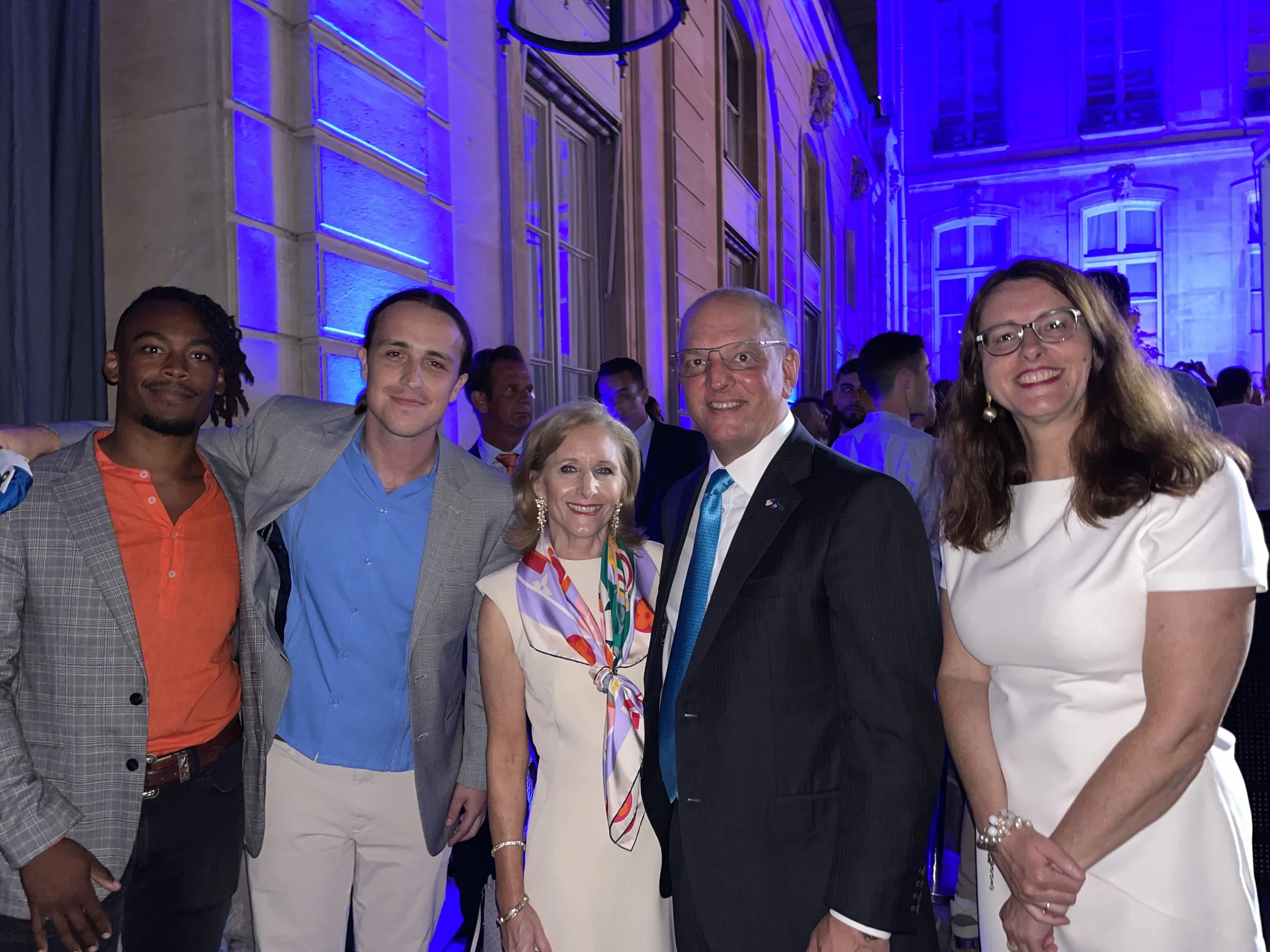
Edwards and his wife Donna at the Fête de la Musique with Drake LeBlanc and Will McGrew of Télé-Louisiane (left), as well as the Consul General of France in Louisiana Nathalie Beras (right). Will McGrew/Télé-Louisiane
McGrew is in France for a series of business meetings with the predominant French media outlets including France Télévisions, France Médias Monde, and TV5Monde, and he met briefly with French Presidential Advisor Emmanuel Bonne and French Minister of Culture Rima Abdul-Malak, who expressed support for cultural and media partnerships along these lines.
A rising star in Cajun and Creole music in Louisiana, Thibodeaux spoke with Macron, who recognized him from his trip to New Orleans. Thibodeaux shared with the French president his hope that our endangered French language can be the bedrock of Louisiana-France ties going forward.
“The President thanked me for being there, and I thanked him for having me,” Thibodeaux said. “I’m proud I was invited and that Louisiana was represented at the Palace. I hope a Cajun or Creole musician who speaks French can return to play a concert there, too.”
After Emmanuel Macron’s Visit, Louisianans Look for Opportunity
The December visit by the French president showcased the importance of the French language in the state. Some francophone and creolophone leaders and activists hope for a chance to make real progress.
The December visit by the French president showcased the importance of the French language in the state. Some francophone and creolophone leaders and activists hope for a chance to make real progress.

On December 2, 2022, French President Emmanuel Macron addressed a crowd of francophone and creolophone leaders at the New Orleans Museum of Art. Jo Vidrine/Télé-Louisiane
By Jonathan Olivier
During French President Emmanuel Macron’s December 2 address to members of Louisiana’s francophone and creolophone communities at the New Orleans Museum of Art, he emphasized his country’s historic linguistic bond with Louisiana.
“The people of Louisiana considered that to choose a language was to continue to be faithful to one’s values, to a struggle, to their history, to an identity,” he told the crowd, later adding, “We’re going to continue to protect this language that has been defended and chosen.”
Macron chose New Orleans, one of the most important symbols of France’s historical connection to the United States, to announce the creation of a fund to expand French language programs throughout the United States called French for All. His trip to the Bayou State was the first from a French president in nearly 50 years, which also coincided with a stop in Washington D.C. to meet with President Joe Biden.
French for All “aims to make bilingualism accessible to a wider and more diverse audience, equipping the next generation of learners with the tools they need to succeed in a globalized world,” according to a news release from the French-American Cultural Exchange in the Education and the Arts Foundation.
Yet, since Louisiana is already deeply invested in French-language education, French for All isn’t necessarily targeting the state for such an initiative, according to Audoin de Vergnette, press officer for the Consulate General of France in New Orleans. Instead, Louisiana francophone and creolophone leaders are aiming to capitalize from the attention generated by Macron’s December visit.
Rep. Mike Huval, R-Breaux Bridge, plans to use the high-profile visit in order to demonstrate the importance of French in Louisiana to his fellow representatives. “It’s due to the French language that the president came to Louisiana,” said Huval, a native creolophone who shared a brief exchange with Macron. “We can see that this language is incredibly important.”

During his address, Macron emphasized his country’s historic ties to Louisiana before announcing his new initiative, French for All, which aims to strengthen French-language education in the United States. Jo Vidrine/Télé-Louisiane
Along with his colleagues, Speaker Pro Tempore Tanner Magee, R-Houma, and Senate President Page Cortez, R-Lafayette, Huval was pivotal last year in establishing the largest budget in state history dedicated to the French language, which totaled $4 million. During this year’s legislative session, which begins on April 10, Huval plans to work with Magee and Cortez, as well as Sen. Jeremy Stine, R-Lake Charles, Rep. Joseph Orgeron, R-Golden Meadow, and Rep. Beryl Amedée, R-Houma, to secure more funding for French in 2023. Huval said he believes that the momentum from Macron’s visit will work in their favor.
“The fire has been lit and it’s time to take advantage of that,” said Huval, who is serving his last year as a state representative due to term limits.
Initiatives that could be good candidates for receiving government funds include the Saint Luc French Immersion and Cultural Campus, a non-profit education facility located in Arnaudville. Saint Luc officials are currently working to finish renovations of the building they purchased in 2019 for $184,000. Other proposals advocates have discussed with legislators include continuing Télé-Louisiane’s French programming partnership with Louisiana Public Broadcasting, expanding bilingual signage, and increasing funding for immersion programs through changes to the state’s Minimum Foundation Program.
The state set a new precedent for funding these sorts of projects in 2022. The legislature passed HB261, which was authored by Magee, creating École Pointe-au-Chien, the first French immersion program in Terrebonne Parish and the first Native American school in the state. Signed by Gov. John Bel Edwards in June, the $3 million investment proves that French’s status in the state is growing, according to Christine Verdin, who is spearheading the creation of the school in the community of Pointe-aux-Chênes.
For Verdin, Macron’s visit is a sign that the state’s investment in her project was well warranted, and that funding for similar ones should be on the table this year. “Macron came here because I believe that the people of Louisiana are important to him and he would like to bring French back here,” said Verdin, who is a councilmember of the Pointe-au-Chien Indian Tribe.
Funding for French Immersion Programs
Louisiana French immersion programs already benefit from France’s help. French officials coordinate with the Council for the Development of French in Louisiana (CODOFIL) to vet teachers who come to the state in order to instruct in immersion programs, allowing them to remain with a special visa for several years. Currently, there are around 5,500 students enrolled in 32 programs statewide. Some of these programs, such as the public charter school Lycée Français de la Nouvelle-Orléans, follow both Louisiana curriculum and a French version in coordination with the Agency for French Education Abroad.
French immersion education has been tasked with maintaining and growing a population of Louisiana francophones. Due to that reason, Jourdan Thibodeaux, a musician from Cypress Island who briefly met Macron, suggested that more needs to be done to support immersion programs.
Thibodeaux, who has a daughter enrolled in the immersion program at Cecilia Primary School, pointed out that it’s the only school in the parish with an immersion program. There are nearly 7,400 students enrolled in public schools across St. Martin Parish. “All of the children in St. Martin Parish are Cajun and Creole. So, why do we only have one French immersion program? Because we don’t have the money. So, for me, money is the most important factor.”

Rep. Mike Huval (right) and Jourdan Thibodeaux (center) briefly met French President Emmanuel Macron during his visit. Jo Vidrine/Télé-Louisiane
Since funding for Louisiana’s schools comes from a mix of local, state and federal dollars, Thibodeaux hopes that Macron’s visit sends a message to the state legislature. If the existence of French in Louisiana can attract the president of France, Thibodeaux reasoned that strengthening the language here can only work in Louisiana’s favor.
“Perhaps our government officials will be more engaged with our people, with our culture,” he said.
Intergovernmental outreach between Louisiana and France is what lured Macron to Louisiana in the first place. In August, Edwards went to France and the Netherlands in order to tour flood control facilities and seek economic development opportunities for Louisiana. In the aftermath of Edwards’ visit, the French Consulate and Embassy coordinated with local government partners over a period of several months to make Macron’s visit to New Orleans a reality.
During Macron’s December trip, he witnessed the signing of an agreement of understanding between Edwards and Catherine Colonna, the minister for Europe and Foreign Affairs, which established intent to create a position for a French expert to aid in the transition to clean energy.
The efforts by Edwards and other government officials were well worth it, according to Lawson Ota, founder of Tours by Marguerite in New Orleans. He also lauded the efforts of New Orleans Mayor LaToya Cantrell, who visited France for four days last July, but who was criticized for spending around $45,000, which included a first-class plane ticket. Ota has already noticed an uptick in French tourists who, he estimated, were lured to Louisiana by the coverage of Macrons’ visit.
“I think that the importance of his visit is to remind the francophones of the world that Louisiana exists, that Louisiana has an important place in the francophone world, and that we’re still here,” he said. “French isn’t just an anecdote from the past. It’s a part of our reality today.”
For Thibodeaux, these sorts of relationships are exciting developments that demonstrate French’s economic potential in Louisiana. While once the language was seen as a one-way ticket to the bottom rung of the economic ladder, today it’s an asset to speak multiple languages.
Thibodeaux said he sees French immersion serving as the initial step to grow Louisiana’s population of French speakers. What has to come next are economic opportunities that allow them to use French in their daily lives. “If you want to have children who speak French in the future, you need opportunities for them,” Thibodeaux said. “They’ll be able to find more opportunities compared to other people who only speak one language.”
Macron to Begin New Orleans Visit Friday in Jackson Square (Read His Full Agenda Here)
The French President’s schedule includes a meeting with the Governor, a speech on Louisiana’s French language, and strolls around the French Quarter and Frenchmen Street.
The French President’s schedule includes a meeting with the Governor, a speech on Louisiana’s French language, and strolls around the French Quarter and Frenchmen Street.

© Rémi Jouan, CC-BY-SA, GNU Free Documentation License, Wikimedia Commons
Will McGrew, CEO, Télé-LouisianeYesterday evening, the French Consulate in Louisiana announced the first official details on President Emmanuel Macron’s agenda for his historic daylong visit to New Orleans—the first by a French President in nearly 50 years.
After arriving from Washington, President Macron will kick off his visit in the heart of the French Quarter— Jackson Square—where he will be welcomed by Mayor Latoya Cantrell and other officials before taking a walking tour of the Vieux Carré.
Next, he will meet with Governor John Bel Edwards at the Historic New Orleans Collection to discuss climate issues. At the HNOC, Governor Edwards will sign an agreement with French Foreign Minister Catherine Colonna in the presence of President Macron that will, among other things, create a role on the Governor’s Climate Initiatives Taskforce for a French technical expert in the energy transition.
Turning to Louisiana’s world-renowned language and culture, President Macron will then give a speech at the New Orleans Museum of Art on the persistence of the French language in Louisiana and the central role it has played historically and contemporaneously in Louisiana’s unique culture and identity. The audience will include cultural and political leaders in the State’s Cajun, Creole, Bayou Indian, and other French-speaking communities.
In the evening, President Macron will be joined for dinner by members of the music and film industries. And finally, the President will close out the night in the City’s historic district, walking down Frenchmen street to listen to the city’s famous jazz bands, before returning to the airport to fly back home to Paris.
The final stop on his visit, Frenchmen Street, is not only festive but also symbolic. The street was named for the French-speaking Louisiana Creoles who were executed for revolting against Spanish rule in defense of self-determination for the people of Louisiana. Often forgotten, this Louisiana Revolution of 1768 was the first popular upheaval inspired by the ideals of the Enlightenment—8 years before the American Revolution and 21 years before the French Revolution.
Macron’s day trip to the Bayou State comes after several years of intense political and cultural efforts to maintain Louisiana’s cherished yet endangered linguistic identity. In the past two years, Télé-Louisiane has worked with partners across the State to negotiate the largest State budgets in history for French language initiatives—$800,000 in FY 21-22 and $4 million in FY 22-23. The latter number includes $264,000 in funding for Télé-Louisiane’s programming partnership with Louisiana Public Broadcasting, and $3 million for École Pointe-au-Chien. Since 2018, Louisiana is the only US State to be a member of the Organisation Internationale de la Francophonie although this status has not yet facilitated additional support for Louisiana’s endangered French language.
French President Emmanuel Macron to Visit Louisiana December 2
The visit will showcase Louisiana’s unique French language and culture and will be the first by a French President in almost 50 years.
The visit will showcase Louisiana’s unique French language and culture and will be the first by a French President in almost 50 years.

© Rémi Jouan, CC-BY-SA, GNU Free Documentation License, Wikimedia Commons
Will McGrew, PDG/CEO, Télé-LouisianeAfter much speculation, the news is now official: the President of the French Republic Emmanuel Macron will visit New Orleans on Friday, December 2. Télé-Louisiane broke the news last Friday after receiving confirmation from the French Ministry of Foreign Affairs. We were the first US and Louisiana media outlet to confirm the visit.
President Emmanuel Macron will be in the economic capital of Louisiana for one full day following his state visit to Washington, DC. The three focuses of his tour to the Bayou State will be the persistence of the French language in Louisiana, climate change, and the unique culture and music of our State. The President’s agenda will include a meeting with Governor John Bel Edwards on climate, a second-line in the French Quarter, and an event dedicated to the French language in Louisiana and the United States.
On the final point, Macron plans to announce a new US-wide program funded by the French government to support French language education, but no Louisiana-specific educational initiatives have been announced despite the State’s unique relationship with the French language.
Macron will be the third French President to visit Louisiana and the first in almost 50 years—after Charles de Gaulle in 1960 and Valéry Giscard d'Estaing in 1976.
Updated November 28. More information to come.
Law endangering high school language classes passes despite outcry from French-speaking Reps, community groups
SB191 would allow computer science to replace the language requirement in TOPS for students graduating after 2026, but the law could still be vetoed by Governor John Bel Edwards.
SB191 would allow computer science to replace the language requirement in TOPS for students graduating after 2026, but the law could still be vetoed by Governor John Bel Edwards.

Senator Sharon Hewitt (front center) seated with colleagues in the Louisiana State Senate, 2022 Regular Session (Télé-Louisiane).
Will McGrew, CEO & Editor in Chief, Télé-LouisianeIn the final day of its 2022 Session, the Louisiana House of Representatives approved the Conference Committee report for SB191 authored by Senator Sharon Hewitt by a vote of 54 to 41. The Senate had unanimously approved the report earlier today.
The bill, which allows computer science to replace foreign language classes for students graduating in 2026-27 and afterwords, now heads to Governor John Bel Edwards’ desk for a signature or veto.
Despite proponents’ claims that students will have the choice between CS and language classes, language educators point out that School Districts and high schools will be financially incentivized to terminate language teachers and classes for cheaper online computer science offerings. Télé-Louisiane has reviewed correspondence to local educational authorities by computer science service providers taking advantage of the new context created by the bill.
ULL student Annie Bates and French immersion educator Lindsay Smythe Doucet discussed this core fiscal critique as well as other negative economic, educational, and cultural impacts of SB191 in op-ed’s for Télé-Louisiane. Smythe, Télé-Louisiane, and other advocates including Matt Diez (President of Louisiana Parents for French Immersion) and immersion expert Terri Hammatt communicated these concerns directly to Senators and Representatives in Baton Rouge.
While it eventually passed both Houses, SB191 mobilized strong opposition in the French-speaking community in the House of Representatives and across the State. Representative Mike Huval and Representative Beryl Amedée played key roles in particular, and nearly all of the Acadiana Delegation opposed the final version of the Bill along with a handful of members from the Orleans Delegation and Black Caucus.
Language education supporters are encouraged to contact Governor Edwards to share their views on SB191 ahead of his decision on a signature or veto in the coming days.
State Legislature votes unanimously to open first Indian French immersion school École Pointe-au-Chien
Approved Tuesday in the Senate, HB 261 will allow École Pointe-au-Chien to begin serving students from Indian French and Cajun families in Terrebonne and Lafourche in August 2023.
Approved Tuesday in the Senate, HB 261 will allow École Pointe-au-Chien to begin serving students from Indian French and Cajun families in Terrebonne and Lafourche in August 2023.
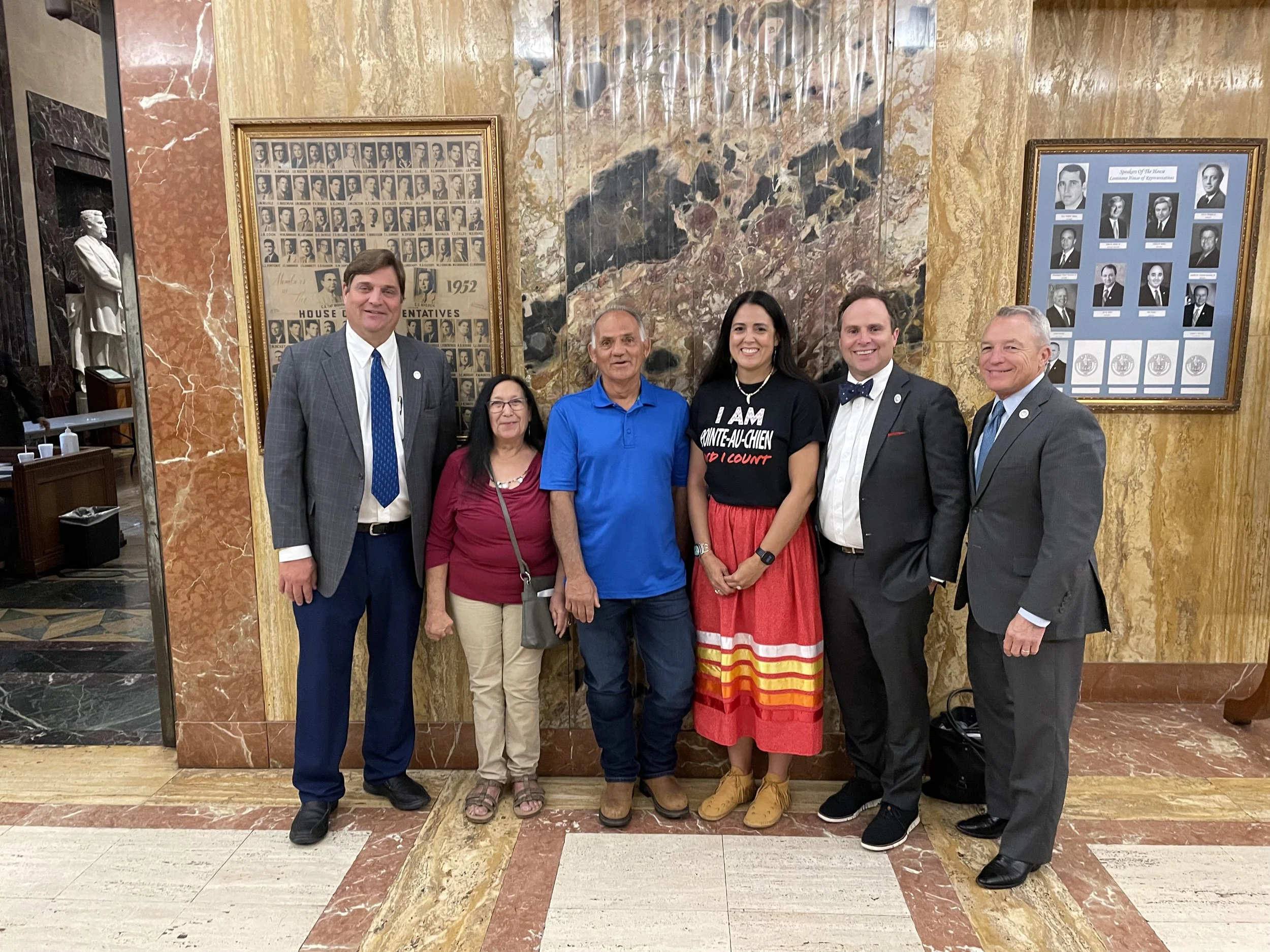
From left to right: Representative Joseph Orgeron (Lower Lafourche); Theresa Dardar, Pointe-au-Chien Indian Tribe; Patty Ferguson Bohnee, Pointe-au-Chien Indian Tribe and ASU Law Professor; Donald Dardar, Vice Chairman, Pointe-au-Chien Indian Tribe; Representative and Speaker Pro Tempore Tanner Magee (Terrebonne); Representative Mike Huval (St Martin). May 31, 2022, Louisiana Sate Senate (Télé-Louisiane).
Will McGrew, CEO & Editor in Chief, Télé-LouisianeUpdated June 3, 2021 at 6:30 pm to reflect the outcome of the Conference Committee report.
In an unprecedented move, the Louisiana State Senate considered and unanimously approved Tuesday an ambitious bill to open École Ponte-au-Chien, realizing a longtime dream of the unique Indian French and Cajun down the bayou community. 35 Senators supported the initiative, and none voted against it. The House of Representatives did the same in April with 97 affirmative votes.
The school will be a public special school similar to NOCCA in New Orleans or LSMSA in Natchitoches with an independent Board, whose members will be majority-appointed by the Native Tribes of the bayou region of Southeastern Louisiana. It will be the first French immersion school in the heavily francophone parishes of Terrebonne and Lafourche and the first Indian French school in the country.
École Pointe-au-Chien will most likely be based in the property of the former Pointe-aux-Chênes Elementary School (Pointe-au-Chien is the original indigenous version of the name). Elementary-age children in this Indian French and Cajun village divided by the Bayou which bears the same name had studied there for generations before the school’s sudden closure by the Terrebonne Parish School Board last year.
The school is an important symbol for the Pointe-au-Chien Indian Tribe based down the bayou in lower Pointe-au-Chien : it represents not only a community pillar in the recent history of its people but also a reminder of the fierce discrimination that prohibited local Natives from attending the school before the 1960s and then punished them for speaking their dialect of French after they were allowed to enroll in the following decades.
HB261 was authored by Representative and Speaker Pro Tempore Tanner Magee from Terrebonne with 18 co-authors including Senate President Page Cortez from Lafayette and the rest of the House delegation from lower Terrebonne and Lafourche: Beryl Amedée, Joseph Orgeron and Jerome Zeringue. Senator “Big Mike” Fesi who also represents this region defended the law in the upper chamber.
The House of Representatives rejected some of the Senate's technical amendments this morning, and a Conference Committee was organized to finalize the Bill by June 6. Senator Fesi and Representatives Orgeron and Magee were appointed to the Committee along with Senator Jeremy Stine (a French immersion graduate representing the Lake Charles area), Senator Katrina Jackson, and Representative Lance Harris (the Education Committee Chair). The final version of the Bill was submitted to the Legislature by the Conferees on June 2, 2022.
After a signature from the Governor expected in the coming weeks, École Pointe-au-Chien will become an official state entity in July 2022 and will open for students between Pre-K and 4th grade in August 2023. In the meantime, the School's Board of Directors will be constituted and charged with spending the $3 million budget allocated by the Legislature to rebuild from Hurricane Ida and prepare for the (re)opening scheduled for August 2023.
This Bayou Indian community’s fight with allies across the State has become one of the leading causes of the contemporary Louisianist movement, and its success represents the largest single investment by the State of Louisiana in its unique French language and heritage since its admission to the Union.
Smythe: Reject SB191 to Save Heritage Language Education
Louisiana’s legislators must act to protect heritage language education endangered by the current version of SB 261, writes French immersion educator Lindsay Smythe.
Louisiana’s legislators must act to protect heritage language education endangered by the current version of SB 261, writes French immersion educator Lindsay Smythe.

Des élèves du programme d’immersion française à l’École primaire Têche à Cecilia dans la paroisse de Saint-Martin de la Louisiane (Drake Leblanc, Télé-Louisiane)
Lindsay Smythe Doucet, Contributing Author - Sunset, LouisianaThis op-ed is adapted from a letter sent by Lindsay Smythe, a seasoned French language teacher and the current director of one of the newest French immersion schools in Louisiana. She encourages language education supporters in Louisiana to contact their Representatives directly via email or the LFLTA advocacy form. The views expressed are her own. Télé-Louisiane is working with legislators, community partners, and French language educators to legislatively protect language education in the TOPS framework.
As a foreign language educator and one of your constituents, I write to ask our elected representatives in the Louisiana’s House of Representatives to formally oppose Senate Bill 191, which would change the curriculum requirements which grant eligibility for TOPS to allow computer science/coding to count as a world language/foreign language requirement. I urge the House to reject this bill as is unless amendments are put in place to protect world language programs in our State.
My name is Lindsay Smythe, and I’ve been an educator for 17 years, first in Cameron Parish and then in Lafayette Parish. For the last eight years, I was a French and English teacher at Lafayette High School, where I served as French department head and director of an academic exchange with a high school in Paris, France. As you know, I changed roles this past year and am now the principal of a French immersion elementary school in St. Landry Parish. In these roles, I have seen the benefits of second language acquisition for students, and I am deeply concerned about the potential negative effects in the passing of SB 191.
The Legislature and the Governor should reject in summary for the following reasons which I discuss in further detail below:
As its name states, computer science (including coding) is a science, not a humanities. One cannot simply replace the other. If computer science is deemed important enough to allow for TOPS, it should be listed in science electives or computer science skills should be added to graduation requirements.
As one of the only states with a governmental agency to preserve bilingualism in our state (CODOFIL), and in a state where tourism is the 4th highest employer, it would be counterproductive to lower our population of bilingual speakers.
With the bill written as-is, districts could simply close all foreign language departments. In a state (and nation) where teachers are leaving the profession at a high rate, the last thing we need to do is endanger the jobs of those who have chosen to stay. It is also a detriment for students, as students who take computer science would lack the language requirements to apply to most universities in the United States.
Computer science is already offered in many Louisiana high schools, and students can take it as an elective to graduate (both those in TOPS and Jumpstart pathways). In a nation where students are already lagging behind in second languages, we should not be removing this requirement as an option.
Computer science/coding is a science, not a humanities.
This legislation proceeds that the study of computer coding and world languages is the same and that one can be substituted for another. Code.org, an organization dedicated to expanding access to computer science in schools, formally opposes legislation like this that would allow students to opt out of foreign language for coding. To quote Hadi Partovi, Code.org's CEO, "The only people who would suggest that computer science is akin to learning a foreign language have never coded before." The CEO of the International Society for Technology in Education (ISTE), Richard Culatta, released a statement on June 8th, 2021 further emphasizing that, "We must strengthen world language instruction and allow students to learn world languages and also about the cultures from which they arise, which is key to creating inclusive school communities. I urge state legislatures and the US Congress to rethink efforts to recategorize coding and computer science courses as a world language."
Foreign languages courses teach far more skills than the language itself. The study of foreign languages not only broadens students’ perspectives of the world, but also imparts a more profound understanding of their own cultures. It additionally increases students’ skills in the use of English. It is often the foreign language classroom where students gain the greatest understanding of grammar and expansion of their vocabulary. The study of cultures in language classes gives a greater understanding of one’s own culture and appreciation for a wide range of other subjects, including art, music, cuisine, film, science, and philosophy.
Bilingualism is important for business.
Language study benefits all students as evidenced by decades of research showing improved overall academic achievement and enhanced cognitive abilities of those who study a second language. According to the Louisiana Department of Culture, Recreation and Tourism website, the tourism industry is the 4th highest employer in our state, and without proper second language skills, we risk hurting a major industry in our state. Additionally, there is a wealth of data showing employers need workers with language skills, including employers here in Louisiana. A 2019 report from the American Council on the Teaching of Foreign Languages, entitled "Making Language Our Business," found that 9 out of 10 US employers rely on employees with world languages skills, and 1 in 4 employers lost business due to lack of world language skills.
Both teacher jobs and university-bound students will be at risk.
If Computer Science is allowed to replace foreign languages as an elective, it also means that districts or individual schools will be allowed to opt to close entire foreign language departments as long as they offer computer science. Additionally, four-year universities (both in and outside of Louisiana) require at least two years of a foreign language, and though a student may be able to graduate under this new legislation, they would be unable to use Computer Science as a substitute for university admissions. Even if Louisiana changes its TOPS requirement, it has no power over other states.
I hope you will recognize that SB191 presents a false choice between two unrelated disciplines that would limit opportunities for Louisiana's students to develop skills and understanding they need more than ever in today's world and workplace. The passage of this legislation would be a direct disservice to all students of Louisiana (and Louisiana as a whole), and I respectfully ask that you reject this bill in the House, as well as any others that would weaken the world language requirement for TOPS.
Lindsay Smythe is French immersion educator and avocate for heritage language education in Louisiana. She was born in Cameron, LA and currently resides in Sunset with professional experiences in both the Lafayette Parish and Cameron Parish Public Schools. She is a graduate of LSU and has been a student an dSainte-Anne’
PAC Elementary Parents File Lawsuit Alleging Violations of US, Louisiana Constitutions in Closure Decision
In a complaint filed Friday with the Eastern District of Louisiana, the parents argue the school closure is arbitrary, discriminatory on the basis of race, language, and national origin, and thus unlawful.
In a complaint filed Friday with the Eastern District of Louisiana, the parents argue the school closure is arbitrary, discriminatory on the basis of race, language, and national origin, and thus unlawful.

- Four current Pointe-aux-Chênes Elementary students protest the school’s closure outside the Terrebonne Parish School Board with Pointe-au-Chien Tribal elders Donald and Theresa Dardar on March 16, 2021.
Will McGrew, CEO & Editor in Chief, Télé-LouisianeTwelve parents of current Pointe-aux-Chênes Elementary students, all of whom are Native American and members of the Pointe-au-Chien Indian Tribe filed a lawsuit against Terrebonne Parish School Board, its president Gregory Harding, and its superintendent Phillip Martin in Federal Court for the Eastern District of Louisiana alleging illegal racial, linguistic, and national origin discrimination under Title VI of the Civil Rights Act, the 14th Amendment of the Constitution, and Article 1: Section 3 and Article 12: Section 4 of the Louisiana Constitution, failure to adhere to the requirements of Louisiana’s Immersion School Choice Act, and violation of the State’s public trust doctrine in causing environmental endangerment of a coastal community
The parents, represented by francophone lawyers Louis Koerner of New Orleans and Jimmy Domengeaux of Lafayette, asked the court for urgent injunctive relief to prevent the closure and sale of the school for the 2021-22 school year. Koerner and Domengeaux likewise represent parent Anne Ogden in her ongoing litigation at St. Tammany Parish School Board for its three-time failure to follow the requirements of the State’s Immersion School Choice Act to open a French Immersion program. Domengeaux is the son of James Domengeaux, former U.S. Representative and founder of CODOFIL, the state agency for the promotion of French.
The legal filing constitutes a serious escalation of the efforts of the Pointe-au-Chien Tribe and the Pointe-aux-Chênes bayou community as well as their allies to fight back against the most recent chapter in what they argue is a long pattern and practice of racial and linguistic discrimination against Louisiana-French-speaking Native American and Cajun students in the area. The news coincides with the final few weeks of school at Pointe-aux-Chênes Elementary where teachers have been instructed to prioritize packing boxes at the expense of teaching students according to a community member with direct knowledge of the school’s operations.
Movers are expected at the school on or before June 21, 2021, according to the same community member and two additional sources. All three individuals chose to speak anonymously for fear of retaliation from School Board officials dead-set on closing and selling the school regardless of community backlash—and despite any clear rationale behind the decision. The plaintiffs and their lawyers fear that an expedited sale may be in the works to generate quick cash this summer from what the parents view as an irresponsible sale of an indispensable community pillar.
The absence of any documented financial or other justification is a central focus of the legal arguments made by PAC parents in their emergency filing to prevent the closure and sale of the school in federal court. The plaintiffs point to the integration era and specifically the case Hall v. St. Helena Parish School Board decided by the Eastern District to argue that although the School Board has the general authority to close and consolidate schools, in exercising that power it must do so neutrally, impartially, and without bias. As the court ruled in 1961 in a decision affirmed by the Supreme Court, “absent a reasonable basis for so classifying, a state cannot close the public schools in one area while, at the same time, it maintains schools elsewhere with public funds.”

- Parent Samantha Boudreaux holds a sign to Save PAC at the protest against the closure and sale of the school on April 1, 2021.
In the case of Pointe-aux-Chênes Elementary, the School Board’s burden of proof is even higher under existing federal jurisprudence in the view of the PAC Elementary parents and their lawyers as Native students were denied access to the school for decades by the School Board until a federal court order forced integration. As in the case of the Helena Parish precedent and dozens of other integration lawsuits, they say it is on the School Board to clearly demonstrate its closure decision does not represent further discrimination against the majority-native students population—a difficult proposition given the complaint’s evidence of discriminatory intent and impact.
Specifically, the complaint details evidence of intentional racial discrimination behind the school closure decision by looking to the few rationales publicly provided by School Board members, asserting, “[one] school board member, Vice President Maybelle Trahan, specifically cited the racial composition of the school as a motivation. In particular, she expressed that she had felt socially isolated as a result of attending the school as a child [but] ignored the success of students who have attended PAC Elementary School [and] that PAC Elementary today is a racially integrated school with a critical mass of both white Cajun and Native American students proportionally reflective of the surrounding community.”
Furthering the point, the complaint later concludes: “While consolidating schools to achieve racial integration is a legitimate objective of local school boards, targeting an already-integrated school like PAC Elementary for its majority-Native racial composition (consistent with the composition of its surrounding community) constitutes illegal racial discrimination, particularly when the most segregated majority-white schools under TPSB’s supervision have mostly not been consolidated for the purpose of desegregation.”
Beyond intentional discrimination, the parents believe the clear disparate impacts inflicted by the decision on PAC Elementary’s students are sufficient evidence to enforce an injunction on the closure and sale of the school. As the complaint outlines, the closure of the school displaces PAC’s students, disrupts their learning, particularly for disabled students, deprives their majority-Native bayou town of a community school, and concentrates a large population of students at Montegut Elementary, a school that they allege has inferior facilities vis-à-vis PAC Elementary.
Linguistic discrimination is the second major focus of the complaint—as it is prohibited by the 14th amendement of the US Constitution and Title VI of the Civil Rights Act as well as by the particularly strong protections for linguistic and cultural rights added to the the Louisiana Constitution of 1974 to compensate for historic de facto and de jure discrimination against Louisiana French speakers. With that historical context, the parents—whose first language and/or parents’ first language is Louisiana French—say the denial of two state-sanctioned requests for French immersion and the subsequent closure of the school with its majority of French-speaking families represents discrimination against speakers of Indian, Cajun, or other dialects of Louisiana French—of particular national origins.

- CODOFIL Executive Director Peggy Feehan and La Fondation Louisiane Founder and Chair William Arceneaux and Vice Chair Philippe Gustin during a day of French-language legislative advocacy, including around PAC Elementary, April 21, 2021.
Community members are particularly frustrated that the School Board refuses to accept financial or other support from the community, the State, or allies to keep the School open. Indeed, after State Representative and Speaker Pro Tempore Tanner Magee spearheaded an effort to allocate $1 million in the state budget to reopen PAC as a French immersion school, Pointe-au-Chien Tribal Council Member Geneva Leboeuf and PAC Elementary mom and plaintiff Shana Rae Dardar said the School Board President and Superintendent have still avoided and thwarted efforts to keep the school open without sharing any financial analysis conducted by the School Board justifying the decision. Parents argue the School Board’s position to reject this funding is indefensible to taxpayers as the funding means that the Legislature has exceptionally provided over 70% of PAC Elementary’s $1.4 million annual budget, representing a significant infusion of resources and thereby freeing up funds for other uses by the School and the District.
Télé-Louisiane is working with the Pointe-au-Chien Tribe, the broader Pointe-aux-Chênes community, and relevant public, private, and community partners to ensure the linguistic and cultural rights of French-speaking communities in Terrebonne Parish are protected. Contact us at info@telelouisiane.com to share information that may be helpful to this effort.
Terrebonne School Board Votes to Close Only School in Pointe-Aux-Chênes Bayou Community
Despite an outcry of complaints from the PAC Tribe, community, and their allies and no specific justification for the decision, the School Board voted 6-3 to close the School.
Despite an outcry of complaints from the PAC Tribe, community, and their allies and no specific justification for the decision, the School Board voted 6-3 to close the School.

- Parents, community members, Tribal leaders, and allies gathered to protest against the final vote to close Pointe-Aux-Chênes Elementary, Terrebonne Parish School Board, April 13, 2021.
Will McGrew, CEO & Editor in Chief, Télé-LouisianeThe Terrebonne Parish School Board voted 6-3 to close the Pointe-Aux-Chênes Elementary School, a decades-only community school serving students predominantly from the Pointe-au-Chien Indian Tribe and other Cajun and Indian French speaking families in one of the five bayous of Terrebonne Parish. The School Board members did not provide any specific financial or numerical reasoning for their decision despite the outpouring of concern from community members, researchers, and state officials on the potential economic, cultural, and educational harms of the decision, which now makes Pointe-Aux-Chênes the only bayou in the parish without a school.
In public comments before the April 13 vote, community members argued that the closure decision is the most recent chapter in the School Board’s long history of neglect and discrimination in dealing with the Pointe-au-Chien Indian Tribe as well other Indian-French-speaking Tribes in the Parish, pointing out that Cajun French families have also faced denigration of their language and culture in the region. The Pointe-au-Chien and other Native Americans in the area were initially prohibited from attending Pointe-Aux-Chênes, and following integration, they were banned from speaking their native Indian French language. Chief Shirell Parfait-Dardar of the Grand Caillou/Dulac Band of Biloxi-Chitimacha-Choctaw confirmed her community’s shared historical struggles as well as their support for access to Indian French immersion programs for all Native students in the parish.

- Community member Andy Metzger reads the LA State House Resolution urging the Terrebonne Parish School Board to save Pointe-Aux-Chênes, Terrebonne Parish School Board, April 13, 2021.
In recent years, the Pointe-Aux-Chênes school has been the site of ongoing efforts to keep the unique bayou community’s heritage alive. Parents and community members are heavily involved in focusing the educational and social experience of the school on the town’s unique Louisiana, Cajun, and Indian French culture and community, participating in the Indian Education Program and twice petitioning for the opening of a French immersion program at the school under the requirements of state law. The School Board failed to meet its legal requirements to open a program both times, providing no reason for this abdication of its duty.
While School Board members made general references to fiscal sustainability, community members and allies believe that the closure decision will actually engender a loss of both public funding and economic activity in the Pointe-aux-Chênes community and the broader parish. Indeed, Pointe-au-Chien Tribal Council Member Geneva LeBoeuf and other parents emphasized that a transition to immersion usually increases enrollment and thus funding and likewise comes with a package of additional funding from the State and international governments. These facts were confirmed by Peggy Feehan, the Executive Director of CODOFIL (the Council for the Development of French in Louisiana), who had received direction from Lieutenant Governor Billy Nungesser to work with the School Board to keep Pointe-aux-Chênes open and turn it into a French immersion school. Nungesser likewise sent a formal letter urging the School Board to reconsider its closure decision.
On a broader scale, former state Senator Reggie Dupree, born and raised in Pointe-aux-Chênes, explained that the federal and state governments have just begun investing millions of dollars to protect the bayous around Pointe-aux-Chênes, specifically including the community around the school, notably the Morganza-to-the-Gulf Hurricane Protection System which received its first funding in January. Pointe-aux-Chênes, resident and Pointe-aux-Chênes Elementary grandmother Sheri Neil noted on the other hand that the local recreation department and the State Department of Wildlife and Fisheries have also invested greatly to make the community more livable and attractive in recent years. Dupree argued that a decision to close the school and preemptively forsake the Pointe-Aux-Chênes residential community would endanger future efforts to gain desperately needed federal support to protect Terrebonne Parish’s many coastal communities.

- The final vote to close Pointe-Aux-Chênes Elementary School is recorded, Terrebonne Parish School Board, April 13, 2021.
Community members feel that in voting to close Pointe-Aux-Chênes without feeling the need to justify their decision, the School Board has essentially sanctioned the ongoing deterioration of the social and economic fabric of the Pointe-aux-Chênes community. As Neil argued—and as was confirmed by several scholarly experts who spoke in defense of the Tribe—a school is a key pillar in maintaining a safe, healthy, and vibrant small town community. While Ford and Dehart critiqued the hastiness of the decision, its devastating community impact, and the numerous possibilities for saving the School, School Board members LaGarde, Harding, Benoit, Solet, Hamner, and Trahan voted to support school closure, seemingly unconcerned wtih the dramatic implications of removing this cultural, educational, and economic pillar of the Pointe-Aux-Chênes community.
Before voting to close the school, Vice President MayBelle N. Trahan offered a few words in Louisiana French, her native language, without indicating whether the School Board had any imminent plans to prevent the language’s likely death by teaching it to the next generation. In a similar vein, Voisin asked that his colleagues seriously consider an immersion program now that the decision has been made to close the School. Such commitments have been offered to the Parish’s Indian, Cajun French, and Creole speaking residents numerous times over the years, but as in the past, no specifics were provided. Télé-Louisiane live-streamed the portion of the School Board Meeting agenda devoted to the Superintendent’s proposal to consolidate Pointe-Aux-Chênes with Montegut Elementary.
Just before the School Board vote, at the urging of Speaker Pro Tempore Tanner Magee, a representative from the area, the Louisiana State House had unanimously passed a resolution urging the School Board to save Pointe-Aux-Chênes—at the potential risk of losing COVID-19 relief funds. While this resolution was insufficient for convincing the School Board, the Tribe and community members stated they will exhaust their legislative, legal, and other remedies to ensure Pointe-Aux-Chênes Elementary’s building continues to be used by and for their community and secure access to Indian French immersion for their students.
Will McGrew, CEO, Télé-Louisiane with reporting from correspondent Sara Guillot
Terrebonne School Board to Close School Serving the French-Speaking Pointe-au-Chien Native Tribe, Causing Community Concern
Community members have mobilized to protest the move, arguing that closure will harm students as well as the unique culture, community, and economic livelihood of the Pointe-au-Chien Indian Tribe and broader Pointe-Aux-Chênes community.
Community members have mobilized to protest the move, arguing that closure will harm students as well as the unique culture, community, and economic livelihood of the Pointe-au-Chien Indian Tribe and broader Pointe-Aux-Chênes community.

- Laurencia Billiot, Pointe-au-Chien Tribe member, Protest at Pointe-Aux-Chênes Elementary, April 1, 2021
Will McGrew, CEO & Editor in Chief, Télé-LouisianeThe Terrebonne Parish School Board announced via its Superintendent the proposed closure of Pointe-Aux-Chênes Elementary School in the lead-up to a March 16, 2021 school board committee meeting, due to the assertion that the school is not sustainable—without specifying the metrics or analyses that resulted in the conclusion. The proposal was approved in committee with a final vote to confirm the change scheduled for next Tuesday, April 13, 2021, at the next full board meeting.
Patty Ferguson Bohnee, Clinical Professor of Law at Arizona State University and an attorney for the Pointe-au-Chien Tribe, said that prior notice was not given to parents or teachers, who have likewise not been informed on the details or criteria behind the closure. Parents have also not been consulted on how the District will maintain its legal obligations to serve PAC’s Native, French-speaking, low-income, and disabled students over the coming year. The dearth of community consultation on behalf of the School District has led many in the community to deem the move arbitrary if not discriminatory.
Bohnee stated that there are at least 99 students enrolled in Pointe-Aux-Chênes Elementary according to the most up-to-date numbers despite the effects of the pandemic and recent natural disasters on student enrollment. The majority of these students are Native American from Indian French-speaking families, predominantly from Pointe-au-Chien as well as Isle-De-Jean-Charles, while most of the other students are from Cajun French-speaking families in the area. The State reports that approximately 90% of the students at Pointe-Aux-Chênes are from low-income or disadvantaged backgrounds with 15% receiving special education services as of 2015.
Indian French is both used to refer to the dialect of Louisiana French spoken in the bayou parishes of Louisiana especially Terrebonne and Lafourche; however, it can also be an umbrella term to describe the Louisiana French spoken by Native American tribes in Louisiana including the Tunica-Biloxi Tribe currently located in Avoyelles Parish. Like all dialects of Louisiana French that in many cases vary with ethnicity and region, the similarities across them are relatively overwhelming.
Comparing Bohnee’s numbers to those the School District offered, Pointe-Aux-Chênes has roughly 20-30 fewer students than Montegut Elementary, the majority-white school that the School Board has decided to leave open and where the PAC students will be sent in the likely case of their community school’s closure. According to Vicki Bonvillain, United Houma Nation member and former member of Terrebonne Parish School Board for the District representing Pointe-Aux-Chênes, the School Board has still not provided any reasonable or fair basis for the decision to close Pointe-Aux-Chênes Elementary, especially in light of the fact that Montegut is not wheelchair-accessible whereas Pointe-Aux-Chênes is.

- Traditional Chief Albert Naquin, Isle de Jean Charles Band of Biloxi-Chitimacha-Choctaw Tribe (holding drum) and Second Chairman Donald Dardar, Pointe-au-Chien Indian Tribe (red shirt with sunglasses) among other community members, Pointe-Aux-Chênes, April 1, 2021
Despite not sharing specifics, the basic rationale provided by Martin and some School Board members to justify the closing of the decades-old community school was the declining enrollment at the school and the funding required to maintain the school—concerns that seem somewhat universal in a parish where many schools are struggling in the aftermath of the pandemic and recent hurricanes as well as economic, cultural, and environmental changes. Bohnee and other Pointe-Aux-Chênes stakeholders push back, arguing that the school receives significant federal and state funds due to its proportionally significant populations of Native and disabled students. Furthermore, the School District has not cooperated in response to outreach from PAC community members in their efforts to increase enrollment and sustain the school for the long term through fundraising, public relations efforts, or programmatic changes.
In particular, despite the community’s natural compatibility with a heritage language immersion program in the view of Shana Rae Dardar and other parents interviewed, the School District has thwarted parents, teachers, and community members’ efforts to increase enrollment through a transition to French immersion.
There are currently 35 French immersion programs in Louisiana enrolling 5597 students compared to 26 schools with 2692 in Spanish immersion and 2 schools with 152 students in Mandarin immersion according to statistics from the Louisiana Department of Education for the 2019-2020 school year. Immersion education in Louisiana can either be administered as an option among two or several curricular tracks in a school or in the context a full-immersion school in which immersion is the exclusive curricular model.
As the most extensive network of French immersion schools in the United States, Louisiana’s immersion community has stood out as one of the gems of Louisiana’s public education system. Michelle Haj-Broussard, Associate Professor of Education at the University of Louisiana – Lafayette and the President of the Louisiana Consortium of Immersion Schools, said, “French immersion has worked in a variety of schools in Louisiana since the early 1980s, not mention in Canada since the late 1960s.”
Underlying the benefits of multilingual education, Haj-Broussard, added, “immersion programs that are a track within a traditional English-language school are clearly successful based on substantial research since the 1970s. More importantly, if the entire school is converted to French immersion, the results show that the school will be even more successful.”
Beyond academic benefits, Bohnee says that the Pointe-au-Chien Tribe as well as other Native Americans in the area expect their school to be culturally responsive to the unique needs of the students it serves. Incorporating cultural context in education “affirms the backgrounds of the students, considers their cultures as strengths, and reflects and utilizes students’ learning styles,” according to researchers referenced by Bohnee.
She added, “Whether they take the form of immersion programs, dual-language programs, or a combination, these efforts are essential to (re)connecting our American Indian youths to the full scope of their identity.”
Bohnee, Dardar, and others in the community believe the development of a culturally informed immersion program would likewise respond to critical needs of students at the school. Haj-Broussard agreed, saying “immersion schools in particular improve outcomes for students who historically struggle academically for a variety of reasons. The International School of Louisiana in New Orleans and FLAIM (Foreign Language Academic Immersion Magnet) in Baton Rouge are two good examples of these benefits.

- Parents, students, and community members attend the protest at PAC Elementary on April 1, 2021.
In recent years, Pointe-Aux-Chênes parents twice mobilized successful petitions for the opening of a French immersion program in Terrebonne Parish, once in 2018 and again in 2020, following the necessary steps for opening a program under Louisiana’s Immersion School Choice Act passed in 2013. The School District both times failed to meet its requirements under the law to sufficiently consult with parents and open a program, according to attorneys Louis Koerner and Jimmy Domengeaux. The School District likewise denied similar efforts by the native-French-speaking United Houma Nation and the Grand Caillou/Dulac Band of the Biloxi-Chitimacha-Choctaw, according to Bonvillain,and Geneva Lebeouf, another Pointe-Au-Chien Tribe member and community leader.
Peggy Feehan, the Executive Director of CODOFIL (a state agency responsible for keeping Louisiana French alive, especially in Native American, Creole, and Cajun communities), says, “CODOFIL is able and willing to work with Terrebonne Parish in helping them establish a French Immersion program, and we are looking forward to it. We think it would be an incredible opportunity to strengthen the talent base and economic potential of the parish.”
PAC parents and community members believe they have evidence that converting PAC Elementary to a French immersion school would be more than sufficient to increase enrollment and save the school. In both petition drives, they received signatures from a significant number of parents of students at Montegut Elementary and other nearby schools who said they would transfer their child to PAC for the specific reason of enrolling in a French immersion program, according to Lebeouf, Bohnee. This is consistent with evidence from other parishes demonstrating increases in academic performance, enrollment, and school funding after conversion of a public school to partial or full French immersion.
Underlying how critical the next few years will be in keeping Louisiana’s unique linguistic and cultural fabric alive, Coco Orgeron, mother of Ed Orgeron, head football coach at LSU and resident of Cutoff, Louisiana, says, “If you don’t teach the kids now, our language is all gone. This is your last chance.”
Despite claims to the contrary by the School District, Pointe-Aux-Chénes parents, teachers, students, and residents point to the fact that French immersion programs come with funding from the State and international partner governments—as Haj-Broussard and Feehan pointed out as well—making them a win-win investment for local school districts. The French Government’s role in supporting Louisiana’s French immersion schools was recently re-affirmed for the next four years at the re-signing of the France-Louisiana accords at the Cabildo last month.
The struggles of the Pointe-au-Chien Tribe as well as those of the Grand Caillou, Isle de Jean Charles, and Houma Indians for French immersion schools echo the demands of Cajun, Creole, and other Louisiana communities for heritage linguistic and cultural educational across the State.
In St. Tammany, the School Board denied three times the successful petitions for French immersion organized by 25+ local parents. The parents have since attempted to litigate the case given their strict adherence to the Immersion School Choice Act, but the lack of enforcement mechanisms in the law have failed to provide them with legal recourse, sanctioning an illegal violation of their parental rights, in the view of the parents as well as their attorneys Koerner and Domengeaux.
Music teacher and member of the Louisiana French band Poisson Rouge Kylie Griffin in Vermilion Parish has likewise attempted to petition for French immersion; however, she has faced significant obstacles from the local School District. Furthermore, since there is already a French immersion program in her parish, it is unclear whether demonstrating demand from additional parents would facilitate the opening of a new program, pointing to the need for legislative changes to strengthen the rights of students and families under the law.

- EJ Grabert Jr., a native Cajun French speaker, and his wife drove from Thibodeaux to support the Tribe’s efforts to save PAC Elementary given their shared support for keeping Louisiana French alive, Pointe-Aux-Chênes, April 1, 2021.
Tribe leader Chuckie Verdin and other members of his generation have emphasized that the decision to close PAC Elementary represents the final episode in a long period of discrimination against the Pointe-Au-Chien Indian tribe and other Native American tribes in the region. The Tribe members were initially prohibited from attending PAC Elementary until a civil rights suit forced integration of the school. Later, after they were admitted, they were prohibited from speaking their native language Indian French in addition facing other forms of bias. Verdin has specific memories of being called names and facing discrimination when he first attended 3rd grade at PAC.
The Pointe-Aux-Chênes school community also serves the French-speaking Isle-De-Jean-Charles Native Americans. This Tribe has experienced many of the same difficulties as the PAC. They are also considered by some academic and media sources to be the first community subject to resettlement due to climate change in the United States. Nevertheless, Bohnee and other tribal members argue that Pointe-Aux-Chênes contend there is no environmental justification for closing PAC Elementary, approximately 10 miles to the North of Isle-De-Jean Charles and inside the state and parish’s levee protection system. Instead, the position of both Tribes, shared by community members, is that the decision to close PAC Elementary creates further economic and cultural harm to a profoundly endangered community.
Bonvillain believes that with the only Native member gone from the School Board, Terrebonne Parish School District has begun a series of closures of Native American schools. The United Houma Nation has sued the Terrebonne Parish School Board for what they allege to be an unauthorized, illegal sale of a historic Indian school. A UHN member, Bonvillain met with Philipp Martin, the Superintendent, to see how many more students would need to enroll in Pointe-Aux-Chênes to avoid closure; after finding a significant fraction of that number, Martin moved the goal posts, positing a different threshold at their next meeting, according to Bonvillain.
Despite not having met with representatives from CODOFIL and the Louisiana Department of Education as would be appropriate under the Immersion School Choice Act, Martin stated at the School Board committee meeting where the closure was provisionally approved that the size of Pointe-Aux-Chênes Elementary was an obstacle to opening a French immersion program. Bohnee, Bonvillain, and others have disagreed, saying there is no still no guarantee that the School District would act in good faith to create an immersion program at Montegut Elementary or elsewhere given their repeated failures to respond to parent requests over the past years in several communities across the parish.
Furthermore, advocates and experts point out that Pointe-Aux-Chênes is still a great candidate for partially or fully transitioning to French immersion. According to Haj-Broussard, “school size is not an obstacle to the creation of a French immersion program.”
“In fact, some of the most successful French immersion schools, such as those in Orleans Parish, began with just a handful of grades and student populations that are even smaller than PAC. Lycée Français is a notable case.” Haj-Broussard added, “Myrtle Place Elementary is another great example of how a traditional public school can transition to immersion. In PAC’s case, younger students could immediately begin immersion whereas older students would initially receive French enrichment classes as all grades gradually transition to full immersion.”

- PAC Elementary parents Mary and Alton Dupree and their children protest PAC’s closure and collect signatures for the opening of a French immersion program, Pointe-Aux-Chênes, Apr 1, 2021.
Members of the Pointe-Aux-Chênes school community gathered outside of the school on April 1, 2021 to protest the school board’s proposal to consolidate PAC with Montegut Elementary. Around two dozen parents, students, and residents attended to demonstrate their solidarity.
The community will again be gathering outside and inside the School Board meeting at 6 pm on Tuesday, April 13 at 201 Stadium Drive, Houma, LA 70360. Organizers from the Tribe and community ask supporters to arrive at 5:00 pm to attend a press conference and protest before the School Board meeting where they want as many community members as possible to speak.
French teacher Djibril Coulibaly will be released by ICE
The former CODOFIL teacher and Louisiana resident of 19 years will rejoin his family and avoid deportation for the time being.
The former CODOFIL teacher and Louisiana resident of 19 years will rejoin his family and avoid deportation for the time being.

(Coulibaly family photo)
Will McGrew, CEO & Editor in Chief, Télé-Louisiane(Une version francophone de l'article est disponible icitte.)
In an email Wednesday afternoon, Djibril Coulibaly's lawyer, law professor Hiroko Kusuda confirmed that her client will soon be released from detention according to an official from Immigration and Customs Enforcement (ICE).
After 19 years in Louisiana, Mr. Coulibaly had been detained by ICE in recent days as a result of visa problems that date back to his time as an immersion teacher in Saint Landry Parish where the School Board did not request the necessary renewal of his immigration status.
This decision comes after a notable mobilization of the French-speaking and educational communities of Louisiana.
Pointing to his role in the community, the executive director of CODOFIL Peggy Feehan had noted: "Although Mr. Coulibaly technically is no longer a CODOFIL teacher, he's part of our larger family, and it's sad for him to be in a situation of this nature. We hope there will be for a resolution for him, his family, and his school community."
This article will be updated with new information as it becomes available.
Foreign Immersion Teachers Granted Approval to Come to Louisiana in August
The US administration will give them an exemption from the Presidential Proclamation barring foreign workers from entering the United States.
The US administration will give them an exemption from the Presidential Proclamation barring foreign workers from entering the United States.

Immersion students at Teche Elementary in Cecilia, Louisiana in 2019.
By Will McGrew
After a wide-reaching effort by the French-speaking community of Louisiana and its allies around the world, the United States Department of State and the Department of Labor will grant exemptions for 70 teachers from France and other countries to receive J-1 work visas in order to teach in Louisiana’s immersion schools during the 2020-21 school year. This group of teachers includes 49 French speakers and 21 Spanish speakers.
“This is a wonderful development accomplished through the hard work of so many people. We are always fortunate to have these teachers in our state, helping connect our students to the rich heritage of the French culture here in Louisiana,” said Lt. Gov. Billy Nungesser, responsible for Louisiana’s authorities to develop language, culture, recreation and tourism, in a statement released today.
Presidential Proclamation 10014, which prohibits the issuing of new visas through the end of 2020, had endangered the immigration status of 73 foreign immersion teachers. Among them, 49 were contracted to teach in French immersion programs during the academic year that begins in August. There are currently more than 5,000 Louisiana students in 28 French immersion programs throughout Louisiana.
Both chambers of the State’s Legislature passed resolutions encouraging federal representatives to work with the Trump administration to provide an exemption to the proclamation. After a wave of citizen inquiries, Sen. John Kennedy (R), and Rep. Clay Higgins (R-Lafayette), among others, distributed press releases demonstrating they were working with the administration to resolve the problem—given the importance of immersion for education, culture, and language in Louisiana.
"It's such an essential element to preserving our rich French heritage — a unique characteristic found nowhere else in the country. [And] it's a critical component to driving our economy," said Rep. Mike Johnson (R-Bossier City), in an interview this morning on KVPI’s La Tasse de Café.
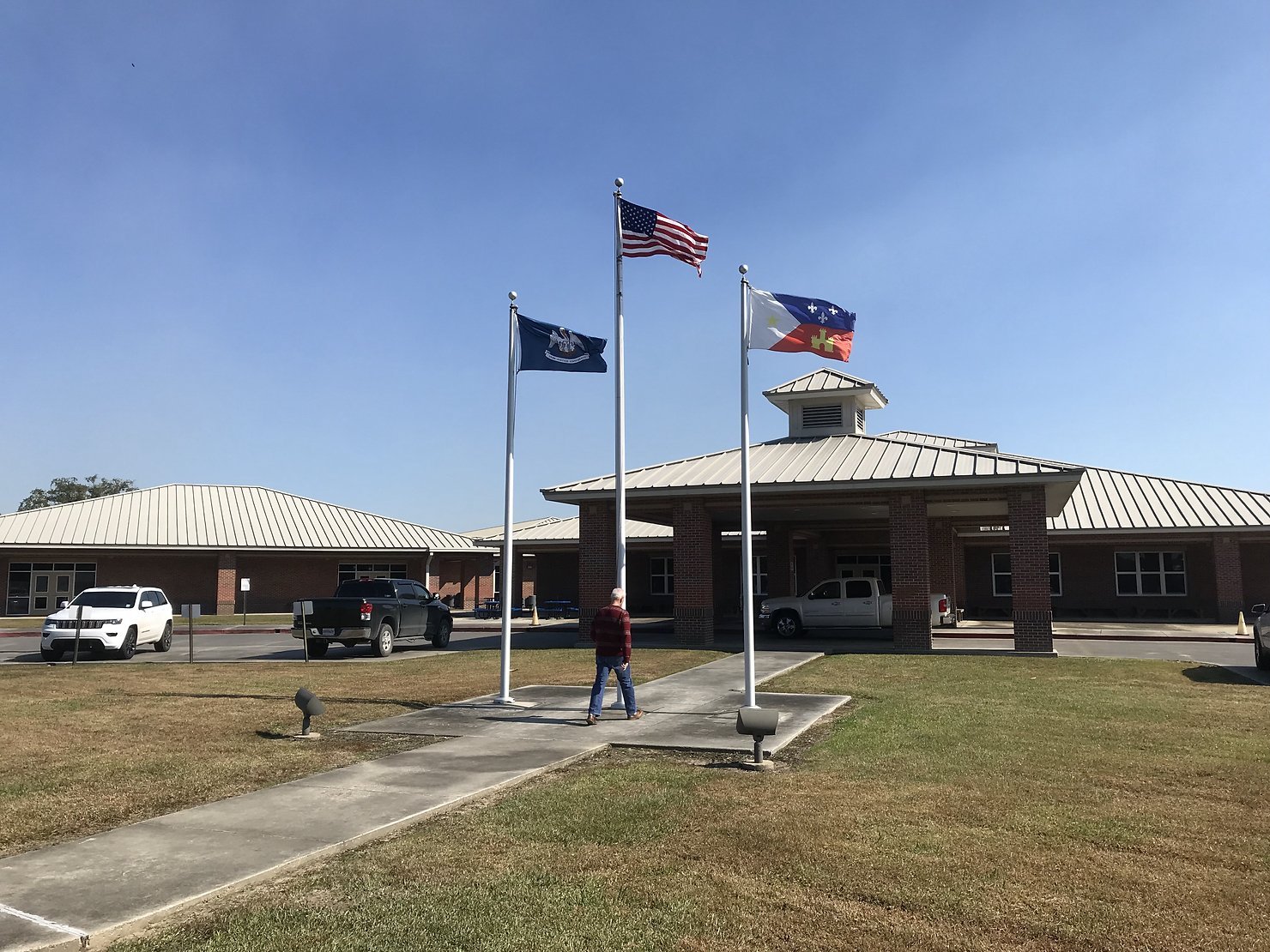
North Lewis Elementary in New Iberia, Louisiana in 2019.
After the proclamation was made public, Télé-Louisiane launched an online petition to request exemptions for the teachers, receiving almost 7,000 signatures in under two weeks. The Council for the Development of French in Louisiana (CODOFIL), the State Department of Education, musician Zachary Richard, the Consulate General of France in Louisiana, and numerous other organizations and individuals explained the severity of the situation to elected representatives of the State and local and international journalists—in particular, by highlighting the potential effects on more than 2,000 of Louisiana’s public schools students. The response from elected officials in Louisiana was fairly quick in the case.
"This victory is a strong demonstration of the dynamism around French education in Louisiana and the solidarity of the Francophone world. Thank you to everyone who mobilized on the ground and those who signed our petition with special gratitude to the Ambassador of France, the Honorable Philippe Étienne for his intervention," wrote Richard.
Procedures to finalize preparations for the teachers' arrival are expected in the coming weeks, but this week's decision has removed the foreign teachers’ biggest obstacle.
“Thanks to the relentless efforts of a terrific team... people here in Louisiana, including Louisiana's Senators and Representatives, as well as our international partners, notably the French Ambassador, the Honorable Mr. Philippe Étienne... our students in numerous French immersion programs will be able to continue learning in French,” said Peggy Feehan, executive director for CODOFIL.