La Veillée returns for second season on LPB
Each week, Télé-Louisiane highlights different aspects of Louisiana culture and way of life in the only Louisiana French TV news show.
Each week, Télé-Louisiane highlights different aspects of Louisiana culture and way of life in the only Louisiana French TV news show.
Drake LeBlanc/Télé-Louisiane
By Jonathan Olivier
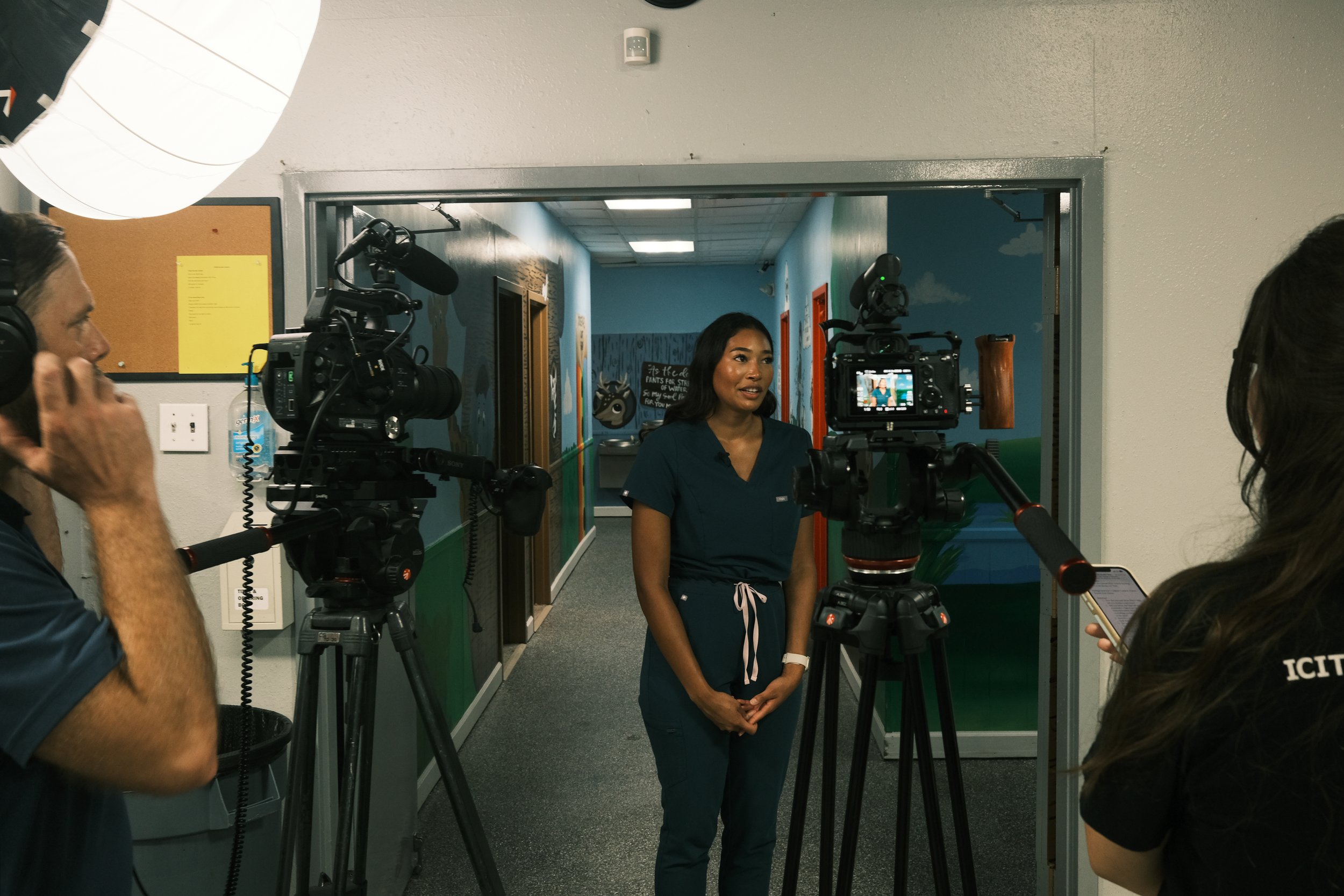
The second season of La Veillée premiered on October 5 on Louisiana Public Broadcasting (LPB). The premiere episode focused on the opening of École Pointe-au-Chien and the school's effort to teach the region’s local French dialect.
The series airs every Thursday at 7:45 p.m. in Louisiana French with English subtitles. It’s part of LPB’s ongoing commitment to showcasing Louisiana’s unique French culture and heritage. “The great viewer response we receive to this series underscores the high interest Louisianans have to the French language, and also to our French history,” said Jason Viso, LPB Director of Programming. “But the interest in La Veillée transcends our Louisiana audience. Thanks to streaming, it has put Louisiana’s French culture in the spotlight throughout the Francophone world, especially in France and Canada.”
La Veillée’s second season will again cover unique and compelling stories across Louisiana. After covering École Pointe-au-Chien in episode 1, the second episode focused on the unique Creole language and culture of the Creoles of Pointe Coupée Parish.

Drake LeBlanc/Télé-Louisiane
Later in the season, the team explores the legacy of Sid’s One Stop Shop in North Lafayette goes back to Pointe-aux-Chênes to talk to shrimpers about the ongoing crisis in the industry, visits the Giant Omelette and French Food Festivals in Abbeville and Larose respectively, conducts an exclusive first interview with the new French Consul in Louisiana Rodolphe Sambou, and paints a portrait of the star of “Swamp People” Troy Landry.
Will McGrew, CEO and Co-Founder of Télé-Louisiane, said La Veillée is necessary as part of the broader effort to keep Louisiana French alive. “Each episode constitutes a new, engaging audiovisual resource for French speakers and learners across Louisiana,” he said. “But La Veillée is about more than just French—the show also tells the unique stories of the people of Louisiana and helps remind us to have pride in our unparalleled culture. We are so grateful to be partnering with LPB in this endeavor for a second season.”
All episodes of La Veillée are available online at Télé-Louisiane and LPB.
The Legend of Pachafa
In Avoyelles Parish, a Louisiana Folktale that transcends time and language
In Avoyelles Parish, a Louisiana Folktale that transcends time and language

No historical images of the Pachafa exist, so this artist rendering provides an idea what the mythical creature looked like. Illustration by Burt Durand
By Natalie Roblin
This article was published in partnership with Country Roads Magazine. Read the article and more here.
Mention the word “Pachafa” in Avoyelles Parish and you’re likely to get at least half of a story. For generations, children have feared the tale of the grisly half-man creature coming to steal them away. As for the other half of the tale…well, it depends who you ask.
“When you were a little boy, there you were alone in the woods, in the cypress swamp,” begins anthropologist and Avoyelles Parish native, Dustin Fuqua. “It’s very quiet. You hear a whistle.” He emits a high-pitch whistle through his teeth, then pauses, “and you look up high, high in the tree. Behold! Pachafa!”
Fuqua recounts the tale in Avoyelles-accented Louisiana French, the way he heard it from family members growing up. “Pachafa starts to come down from the cypress tree,” he continues, looking up. “He sees the little boy. In one hand, he offers herbs; in the other hand, he offers a knife. If the little boy chooses the herbs, he becomes a medicine man. If he chooses the knife, he’ll become a warrior.”
While the story of Pachafa is familiar to residents across the parish, it has a prominent presence in the Spring Bayou, otherwise known as Bayou Blanc, community, which is located a few miles outside the parish seat of Marksville, near the Tunica-Biloxi Tribe of Louisiana reservation. For Fuqua, Spring Bayou is the frightening mise-en-scéne for Pachafa. “The earliest recollection I have of Pachafa was riding in the car in the Spring Bayou Wildlife Management Area,” says Fuqua, who was always told by his mother that Pachafa lived in an old Wildlife and Fisheries maintenance building, near the Boggy Bayou boat launch—only about twenty minutes from his family’s home. Fuqua and his family would make the drive often; fear and anticipation building as they crept down the gravel road, closer and closer to Pachafa’s house.
Spring Bayou Wildlife Management Area spans 12,000 acres across the Red River backwater system. A series of coulees, lakes, and rivers flow through the area and its communities, and with them flows the tale of Pachafa. On the edge of the system, running through the middle of the Tunica-Biloxi reservation, is a canal called the Coulée de Greus, which flows into Old River and then into Spring Bayou. In the story of Pachafa, the Coulée de Greus and Spring Bayou, as well as the Fort DeRussy cemetery in the Brouiliette community, are prominent sites in the Tunica and French Creole tellings. As Fuqua points out, Coulée de Greus is a sacred place where cemeteries were once located and, according to some Tunica tellings of the story, where Pachafa camps out. While Pachafa has no explicit homebase, he hovers near and around these historic waterways and the indigenous mounds surrounding them, never shifting too far geographically. ”His story is pretty localized,” says Fuqua, “and, in my opinion, it’s because of the presence of the mounds.”
Language and Transmission
Language bears on the malleable nature of Pachafa’s story and name. The many iterations of the tale exemplify the complex interaction of culture and language that historically make up Avoyelles Parish. While the most widely recognized name for the legend is “Pachafa,” there are various spellings and interpretations. To children who heard the tale from French or Creole speakers, he became “Johnny Pachafa.” Some, like Fuqua, believe this to be an anglicized version of the French folktale “Jean á patte de fer,” meaning “John with an iron paw,” and referring to a character who has a prosthetic foot. For members of the Tunica-Biloxi Tribe of Louisiana, he was “Tanapachafa,” or simply, “Tanap"—which is originally a Choctaw word associated with war.
Dr. Pete Gregory, who is the curator of the Williamson Museum at Northwestern State University, and Donna Pierite of the Tunica-Biloxi Cultural and Educational Resource Center, translated the Tunica legend to “Tanap apah achafa,” loosely describing a half-man, half-warrior with only one leg. According to Fuqua, Gregory, and Pierite’s research, the word “tanap” might also derive from the Tunica word “tana,” meaning “louse,”—a common slang term for a scoundrel or rascal. The Tunica word, “pachafa” is used to describe someone who walks with a limp—a notorious idiosyncrasy of Pachafa.
Though in almost every iteration of the folklore Pachafa is half-man, besides the other half being a warrior—he might instead be half alligator, or half horse. Occasionally, he is simply described as half of a man—limping along railroad tracks or lurking in nearby woods and fields.
Fuqua and Pierite believe that Pachafa’s story may have been adopted from the Choctaw tale of the “Little People”. Similarly, in this legend, a little boy wanders into the woods and is presented with the choice of a knife or herbs. The Tunica-Biloxi Tribe includes many people of Choctaw descent who, over generations, might have reinterpreted this tale and since preserved the story of “Tanapachafa.” Some Tunica versions reference the herbs and the knife, while other versions pit Tanap against the young boy in a wrestling match.
A Rite of Passage
Members of the Tunica-Biloxi tribe consider hearing the tale of the Tanapachafa as a rite of passage. Pierite, who serves as the Tunica-Biloxi Legends and Songs Keeper, has complex feelings toward Tanap. “There was fear, but there was also respect,” explained Pierite. She recalls the ceremonial way in which her grandmother shared folktales—locking the front door, and then her bedroom door, sitting the children on the side of the bed and, in a low voice, passing the knowledge of Tanap to the next generation.
For Pierite, hearing these folktales was a private and personal event. Growing up, she was told not to tell anyone the stories she heard because people would laugh. Keeping them close to your heart was a way to protect yourself from potential judgment or mocking. Pierite describes the difficulty of initially sharing the folktales with the public at Tunica-Biloxi Pow Wows. Over the years, however, her pride vanquished any fears. “This is our inheritance. This is the treasure,” she said.
The intimate nature of native folktales, coupled with the departure of large numbers of Tunica from the Avoyelles area over the past fifty years, may contribute to the strong association of Pachafa with the lore of the French Creole community in Avoyelles. However, like most of the best Louisiana traditions, the story is an amalgam of the many cultures that make up the area. Each of its diverse retellings is pivotal to its preservation.
An Oral Folktale
In the near decade he’s spent researching the legend of Pachafa, Fuqua has not come across any historical references or written accounts of the legendary spirit, other than a brief description he helped to create for the Pachafa Pale Ale brewed at Broken Wheel Brewery in Marksville. The story is ever-changing, ever-evolving, preserved only within the archive of individual memory. This is perhaps what makes such oral traditions so sentimental; we cling to our subtle variations of the stories as a way to remain close to our identities and our ancestors. It is also what makes the folklore a unifying agent, allowing us to bond over commonalities and shared experiences. As Nathan Rabalais explains in his book Folklore Figures of French and Creole Louisiana, “The paradox of specificity and universality is what gives readers and listeners around the world the peculiar impression of both familiarity and novelty.”
Pachafa is regional and specific; always lurking in proximal locations such as cornfields, bayous, or under nearby bridges. According to Rabalais, this process of substituting decorative or surface-level elements of a story—such as what the other half of the half-man might actually be—is called “localization.” “Localization,” explains Rabalais, “is responsible for the relatability of the tale and an affective proximity to its listener.” The stories change and take on contemporary aspects in order to become most relevant to each community, each family, each person.
Conclusion
To unravel the various versions of Pachafa story is virtually impossible, as each tale is so intertwined with the others—all of them, over time, lending themselves to each other. Today, the area’s French Creoles recall hearing the tale of Johnny Pachafa as a 'tit garçon—or little boy—on weekend rides to the camp with brothers and uncles or fathers and grandfathers, not necessarily realizing this story was itself an adaptation of the Tunica-Biloxi’s folktales of the Tanap.
As to how Pachafa, in every iteration, came to be a half man is unclear. This piece of the story seems to consistently change with each telling, but it is always gruesomely creative—a chainsaw, a train, a woodchipper, the devil. The tales of Pachafa do not exist in straight lines running parallel to each other, but rather, as twists and curves, weaving in and out like bodies of water, sometimes flowing in harmony. And sometimes cutting each other off.
Saint Luc French Immersion Campus terminates project, but local pride remains strong
The board of the non-profit purchased a 1960s-era hospital in Arnaudville in 2019, but after funding and renovation issues will sell the building.
The board of the non-profit purchased a 1960s-era hospital in Arnaudville in 2019, but after funding and renovation issues will sell the building.
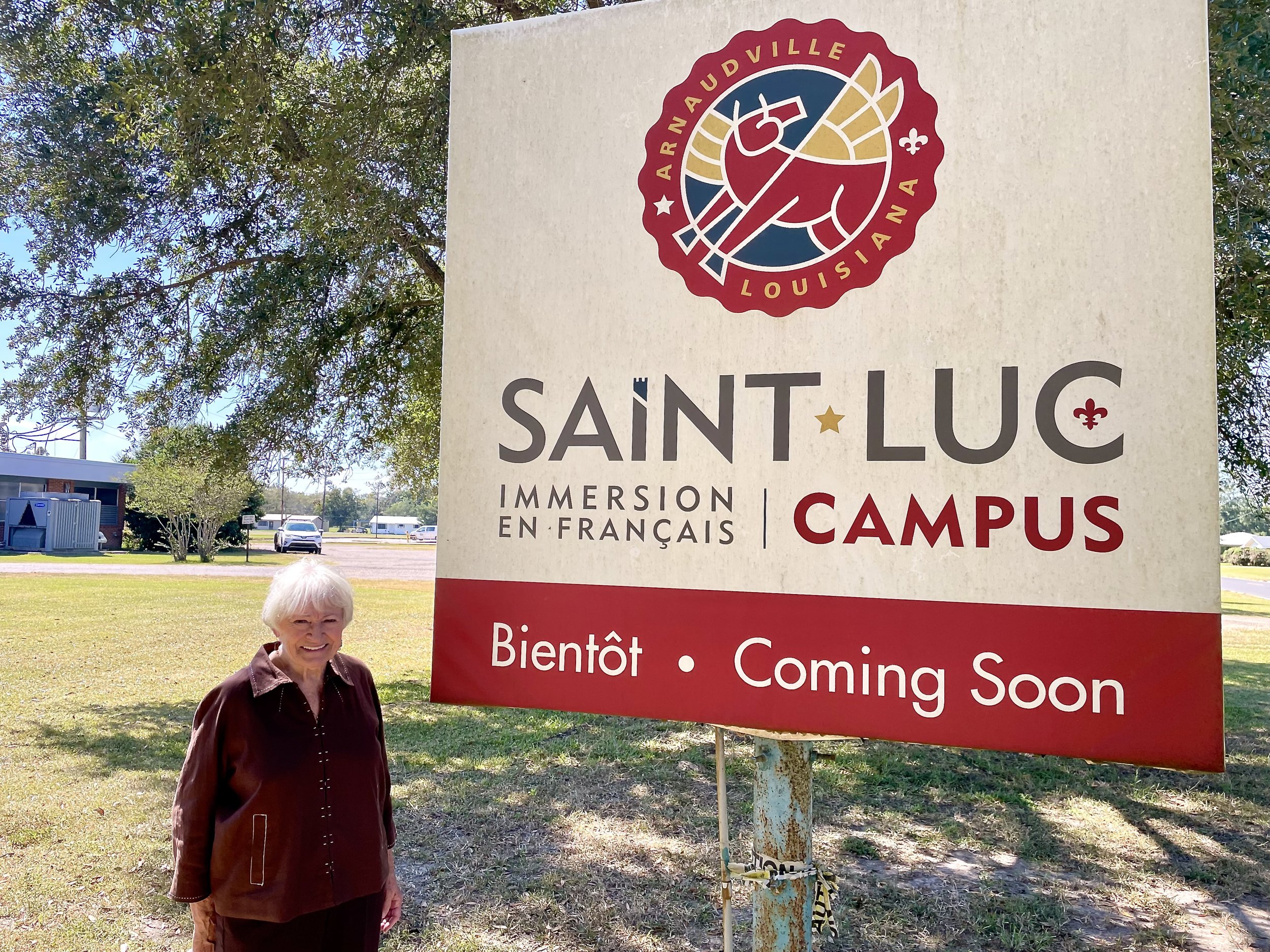
Mavis Arnaud Frugé at the campus of Saint Luc in Arnaudville, Louisiana. Will McGrew/Télé-Louisiane
By Jonathan Olivier
The board of the Saint Luc French Immersion Campus and Cultural Center, located in Arnaudville, announced on Sept. 17 the project will be terminated and the building will be sold.
Saint Luc, a non-profit organization, purchased the St. Luke General Hospital building in November 2019 in the hopes of renovating it to host French immersion courses. After obtaining the building, which was built in 1967 and sat vacant since 1990, officials with Saint Luc raised money and replaced the aged roof, and began cleaning the inside of the building. Over the years, Mavis Arnaud Frugé, the project’s founder, enlisted the help of volunteers to host workshops and classes.
Despite this progress, it became increasingly clear that large capital costs to bring the building up to standard would be insurmountable for the small community organization. The board will now have the building appraised, and after the sale it will refund investors.
Frugé, the former board president of Saint Luc, worked tirelessly to bring the project to life in her small hometown. Her idea to create the Saint Luc program started as a five-day French immersion session in 2005, which was hosted at the NUNU Art and Culture Collective in Arnaudville by former Louisiana French professor at Louisiana State University Amanda LaFleur. Along with LaFleur, Frugé helped coordinate immersive outings with local francophones, activities that included catching crawfish or kayaking. The program came to be known as “Sur Les Deux Bayous,” paying homage to Arnaudville as the confluence of bayous Teche and Fuselier.

The Saint Luc board purchased the vacant St. Luke General Hospital building in November 2019. Jonathan Olivier/Télé-Louisiane
Eventually, other universities caught wind of the project and were interested—Frugé and NUNU volunteers began hosting immersion sessions for students from across the country.
“I met some wonderful people over the years with this project,” Frugé said. “With our pilot program, we brought many students and schools to Arnaudville that came to learn French and learn about our culture.”
In 2008, Frugé and NUNU founder George Marks hatched a plan to purchase the vacant St. Luke General Hospital building and turn it into a first-of-its-kind French immersion program, building upon what they had already established, and looking to the structure at Université Sainte-Anne in Nova Scotia, Canada, for inspiration.
LaFleur, who most recently served as the Saint Luc board president, said the project was never about a building, but rather a community with Frugé at its core.
“Those who have participated in the activities organized by Mavis and her army of volunteers—French tables, immersion programs, workshops, language and craft classes, cultural gatherings, card nights and poetry evenings—form a community dedicated to this cause,” she said. “Mavis, with her enthusiasm and generosity, invited us all to see the jewel that is French Louisiana from a new perspective. And it's clear from the large number of people who return to Arnaudville again and again that this project is a success.”
École Pointe-au-Chien opens as first French immersion school in Terrebonne Parish
On August 16, school leaders and teachers welcomed students in kindergarten and first grade.
On August 16, school leaders and teachers welcomed students in kindergarten and first grade.

Gaëtan Lombard introduces basic French words to the inaugural class at École Pointe-au-Chien on August 16, 2023. Jonathan Olivier/Télé-Louisiane
By Jonathan Olivier
Gaëtan Lombard sat in a low chair in front of his three students, his hand in a panda puppet, leading an ice-breaking activity to coax them into uttering their first word of the day in French.
Bonjour, Lombard repeated over again, until, one by one, his students began repeating the word themselves. These three children, who on August 16 participated in the first day of school of the inaugural academic year of École Pointe-au-Chien, continued their day immersed in French by learning days, months, numbers and simple commands.
School officials welcomed kindergarten and first grade at the Vision Christian Center in Bourg where the school will be housed for a few months until moving to the Knights of Columbus building just a few miles down the road in Pointe-aux-Chênes. After a year or two of renovations at the site of the former Pointe-aux-Chênes Elementary that closed in 2021, the school will move there as its permanent location.
École Pointe-au-Chien, authorized and funded by the state legislature, opened as the first French immersion school serving a predominant Native American population. Christine Verdin, the school’s executive director and a native French speaker from the Pointe-au-Chien Indian Tribe, said her school will be the first to incorporate, on a large scale, the local Louisiana dialects spoken by the Indigenous and Cajun communities nearby. French is still used daily up and down the bayou in these parishes, Verdin said, by grandparents and other family members.

École Pointe-au-Chien opened as the first French immersion school serving a predominant Native American population. Jonathan Olivier/Télé-Louisiane
“Even though Gaëten is French, he has already started adding Louisiana French words into his lessons, because he understands that it’s important for us and our children to learn our French, too,” she said. “We’re including Louisiana French, spoken by Cajuns and Indians, and the culture of the two.”
Cynthia Breaux Seitz, a francophone from south Lafourche Parish, is teaching English language arts and will be supported by Cynthia Owens, a French-speaker from Thibodaux, who is also teaching social living and art.
This focus on local teachers and the continuation of the regional French dialect lie at the core of the school’s mission to both preserve and continue the culture of the many bayou communities that make up Terrebonne and Lafourche parishes. Will McGrew, CEO of Télé-Louisiane and president of the École Pointe-au-Chien State Board, said this aspect sets the school apart from the more than 30 immersion programs in the rest of Louisiana.
“If you look at other minority language situations, the whole point of the schools in the minority language was to keep the language and culture alive as it's spoken there, as opposed to just being a second language,” he said. “Whereas, sometimes when immersion schools in Louisiana are pitched, it's kind of blurred nowadays, where it's like, is it just to learn a second language or is it specifically to keep Louisiana language and culture alive? And with École Pointe-au-Chien, you can really see that, of course you are learning a second language, but the primary impetus for the school is to keep the local language and culture alive.”
In order to introduce students to the region’s French, Verdin said they’ll have francophone members of the community visit for cultural workshops, discussing topics like shrimping and local Indigenous practices like palmetto basket weaving. This focus on continuing not only the region’s language but the culture that it’s tied to is among the reasons École Pointe-au-Chien garnered so much support from state officials. Gov. John Bel Edwards has repeatedly expressed this important point as he has provided support for funding the school.

École Pointe-au-Chien will eventually be housed at the site of the old Pointe-aux-Chênes Elementary. Jonathan Olivier/Télé-Louisiane
“The language and culture of our coastal communities like Pointe-aux-Chênes and Isle de Jean Charles are part of what makes Louisiana a state like no other,” Edwards said. “I’m proud to see the work of this community and leaders in the legislature, especially Speaker Pro Tempore Tanner Magee, to pass this heritage on to the next generation with the creation of the first French immersion school in Lafourche and Terrebonne.”
Rep. Tanner Magee, R-Houma, was outspoken in his support for École Pointe-au-Chien, noting that it’s an added value and an asset to the region. “I am thrilled that Louisiana is investing in our communities and culture by bringing this kind of education to Terrebonne,” he said. “Building all the levees in the world will not matter if we do not invest in the people behind them.”
Rep. Beryl Amedée, R-Houma, who attended École Pointe-au-Chien’s opening day, said that a time when native speakers of Louisiana French are often older than 60, École Pointe-au-Chien is an important tool in the fight to save what’s left. Amedée pointed out that by building a new generation of francophones in the region, these communities will be better equipped to continue what’s been passed down.
“We have a future here,” she said. “We can write new songs in French, for example. We can have new traditions and keep up moving forward with modern times, because we don't just want to preserve the past—we want to continue our culture into the future.”
Smythe: Reject SB191 to Save Heritage Language Education
Louisiana’s legislators must act to protect heritage language education endangered by the current version of SB 261, writes French immersion educator Lindsay Smythe.
Louisiana’s legislators must act to protect heritage language education endangered by the current version of SB 261, writes French immersion educator Lindsay Smythe.

Des élèves du programme d’immersion française à l’École primaire Têche à Cecilia dans la paroisse de Saint-Martin de la Louisiane (Drake Leblanc, Télé-Louisiane)
Lindsay Smythe Doucet, Contributing Author - Sunset, LouisianaThis op-ed is adapted from a letter sent by Lindsay Smythe, a seasoned French language teacher and the current director of one of the newest French immersion schools in Louisiana. She encourages language education supporters in Louisiana to contact their Representatives directly via email or the LFLTA advocacy form. The views expressed are her own. Télé-Louisiane is working with legislators, community partners, and French language educators to legislatively protect language education in the TOPS framework.
As a foreign language educator and one of your constituents, I write to ask our elected representatives in the Louisiana’s House of Representatives to formally oppose Senate Bill 191, which would change the curriculum requirements which grant eligibility for TOPS to allow computer science/coding to count as a world language/foreign language requirement. I urge the House to reject this bill as is unless amendments are put in place to protect world language programs in our State.
My name is Lindsay Smythe, and I’ve been an educator for 17 years, first in Cameron Parish and then in Lafayette Parish. For the last eight years, I was a French and English teacher at Lafayette High School, where I served as French department head and director of an academic exchange with a high school in Paris, France. As you know, I changed roles this past year and am now the principal of a French immersion elementary school in St. Landry Parish. In these roles, I have seen the benefits of second language acquisition for students, and I am deeply concerned about the potential negative effects in the passing of SB 191.
The Legislature and the Governor should reject in summary for the following reasons which I discuss in further detail below:
As its name states, computer science (including coding) is a science, not a humanities. One cannot simply replace the other. If computer science is deemed important enough to allow for TOPS, it should be listed in science electives or computer science skills should be added to graduation requirements.
As one of the only states with a governmental agency to preserve bilingualism in our state (CODOFIL), and in a state where tourism is the 4th highest employer, it would be counterproductive to lower our population of bilingual speakers.
With the bill written as-is, districts could simply close all foreign language departments. In a state (and nation) where teachers are leaving the profession at a high rate, the last thing we need to do is endanger the jobs of those who have chosen to stay. It is also a detriment for students, as students who take computer science would lack the language requirements to apply to most universities in the United States.
Computer science is already offered in many Louisiana high schools, and students can take it as an elective to graduate (both those in TOPS and Jumpstart pathways). In a nation where students are already lagging behind in second languages, we should not be removing this requirement as an option.
Computer science/coding is a science, not a humanities.
This legislation proceeds that the study of computer coding and world languages is the same and that one can be substituted for another. Code.org, an organization dedicated to expanding access to computer science in schools, formally opposes legislation like this that would allow students to opt out of foreign language for coding. To quote Hadi Partovi, Code.org's CEO, "The only people who would suggest that computer science is akin to learning a foreign language have never coded before." The CEO of the International Society for Technology in Education (ISTE), Richard Culatta, released a statement on June 8th, 2021 further emphasizing that, "We must strengthen world language instruction and allow students to learn world languages and also about the cultures from which they arise, which is key to creating inclusive school communities. I urge state legislatures and the US Congress to rethink efforts to recategorize coding and computer science courses as a world language."
Foreign languages courses teach far more skills than the language itself. The study of foreign languages not only broadens students’ perspectives of the world, but also imparts a more profound understanding of their own cultures. It additionally increases students’ skills in the use of English. It is often the foreign language classroom where students gain the greatest understanding of grammar and expansion of their vocabulary. The study of cultures in language classes gives a greater understanding of one’s own culture and appreciation for a wide range of other subjects, including art, music, cuisine, film, science, and philosophy.
Bilingualism is important for business.
Language study benefits all students as evidenced by decades of research showing improved overall academic achievement and enhanced cognitive abilities of those who study a second language. According to the Louisiana Department of Culture, Recreation and Tourism website, the tourism industry is the 4th highest employer in our state, and without proper second language skills, we risk hurting a major industry in our state. Additionally, there is a wealth of data showing employers need workers with language skills, including employers here in Louisiana. A 2019 report from the American Council on the Teaching of Foreign Languages, entitled "Making Language Our Business," found that 9 out of 10 US employers rely on employees with world languages skills, and 1 in 4 employers lost business due to lack of world language skills.
Both teacher jobs and university-bound students will be at risk.
If Computer Science is allowed to replace foreign languages as an elective, it also means that districts or individual schools will be allowed to opt to close entire foreign language departments as long as they offer computer science. Additionally, four-year universities (both in and outside of Louisiana) require at least two years of a foreign language, and though a student may be able to graduate under this new legislation, they would be unable to use Computer Science as a substitute for university admissions. Even if Louisiana changes its TOPS requirement, it has no power over other states.
I hope you will recognize that SB191 presents a false choice between two unrelated disciplines that would limit opportunities for Louisiana's students to develop skills and understanding they need more than ever in today's world and workplace. The passage of this legislation would be a direct disservice to all students of Louisiana (and Louisiana as a whole), and I respectfully ask that you reject this bill in the House, as well as any others that would weaken the world language requirement for TOPS.
Lindsay Smythe is French immersion educator and avocate for heritage language education in Louisiana. She was born in Cameron, LA and currently resides in Sunset with professional experiences in both the Lafayette Parish and Cameron Parish Public Schools. She is a graduate of LSU and has been a student an dSainte-Anne’